
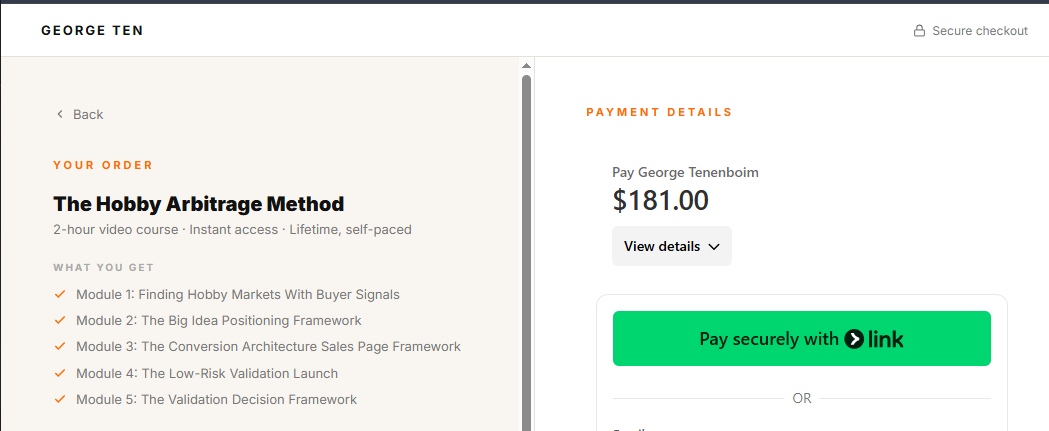
George Ten – Hobby Arbitrage Method
$199.00 Original price was: $199.00.$45.00Current price is: $45.00.
- 24/7 Contact Support & Telegram - Ecomkevin_1
- You Can Request Any Courses
- Original Courses HD Qualite and links updated
Guaranteed Safe Checkout


Description
George Ten – Hobby Arbitrage Method
Discover Profitable Niche Opportunities Without Becoming the Expert
The George Ten – Hobby Arbitrage Method introduces a different way to think about building an online information business. Instead of trying to compete in crowded markets or spending months becoming an expert before creating an offer, the method focuses on identifying hobby and enthusiast markets where people already have strong interests, specific problems, and a willingness to spend money on useful solutions.
At the center of the Hobby Arbitrage Method is a simple question: Where are people already spending money, but where competition for useful information products may still be relatively low?
This approach is designed around market research, opportunity identification, niche selection, and creating information products for targeted audiences. Rather than relying entirely on personal expertise or choosing a business idea based on what seems interesting, the method encourages a more structured way of evaluating markets before investing significant time into building a product.
Whether you are an entrepreneur, marketer, copywriter, affiliate marketer, content creator, or someone looking for a new online business opportunity, the Hobby Arbitrage Method by George Ten offers a framework for thinking differently about niche businesses and information products.
What Is the Hobby Arbitrage Method?
The Hobby Arbitrage Method is based on finding opportunities inside hobby markets and enthusiast communities.
Hobby markets can include almost anything where people develop a strong interest and regularly look for products, information, education, equipment, recommendations, or solutions. These audiences can be valuable because passionate customers often spend considerable time researching their interests and looking for ways to improve their skills or solve specific problems.
The idea is not simply to choose a random hobby and create a product around it. Instead, the method focuses on identifying markets with genuine demand and then determining whether there is an opportunity to create a useful offer for that audience.
This creates a potential path for building an information business around a specific problem, interest, or desired outcome.
Why Hobby Markets Can Be Interesting
Large markets can be extremely competitive. When thousands of businesses are targeting the same broad keyword, audience, or product category, attracting customers can become difficult and expensive.
Hobby markets offer another possibility.
A highly specific audience may have fewer businesses competing directly for its attention. At the same time, members of that audience may be actively searching for information and solutions.
For example, a broad market such as “fitness” contains enormous competition. A much more specific hobby or enthusiast market can have a narrower audience with very different needs, terminology, questions, and purchasing behavior.
The opportunity comes from understanding these smaller markets and identifying what people actually want.
The Hobby Arbitrage Method therefore encourages entrepreneurs to look beyond obvious mainstream markets and investigate specialized communities where demand may already exist.
What You Can Learn From Hobby Arbitrage Method
The Hobby Arbitrage Method by George Ten is centered around evaluating opportunities before spending excessive time building a product.
The framework can help you think about areas such as:
Finding Niche Markets
Learn to look for hobby and enthusiast markets that could potentially support an information business.
Instead of starting with a product and hoping someone will buy it, the process begins with the market and its existing demand.
Evaluating Market Potential
Not every hobby is automatically a good business opportunity.
A market needs to be evaluated based on factors such as audience interest, existing products, competition, purchasing behavior, problems, and potential demand.
Understanding these factors can help you avoid spending weeks or months developing something that nobody wants.
Identifying Problems and Opportunities
Passionate audiences frequently have specific questions and challenges.
The goal is to identify gaps between what people are looking for and what is currently available.
Those gaps can potentially become opportunities for educational products, guides, courses, resources, services, or other offers.
Developing Information Products
Once a promising opportunity has been identified, the next step is considering what type of information product could solve a specific problem.
The opportunity might involve teaching a skill, simplifying complicated information, helping someone achieve a particular result, or organizing useful knowledge into an easier-to-follow format.
Understanding Buyer Demand
A major part of building a successful information business is understanding why someone would actually pay for a solution.
The Hobby Arbitrage approach encourages attention to buyer behavior rather than relying entirely on personal opinions about whether an idea sounds interesting.
Validating Before Building
One of the most useful principles behind the method is the importance of evaluating an opportunity before committing significant resources.
Instead of immediately creating a complete course, website, funnel, or product, market validation can help determine whether the opportunity deserves further investment.
The Go/No-Go Concept
A notable part of the Hobby Arbitrage Method is the Go/No-Go approach.
The concept is designed to make niche evaluation more structured instead of relying entirely on intuition.
The Go/No-Go framework can be used to assess different criteria surrounding a potential market and arrive at a practical decision about whether an opportunity deserves further attention.
Rather than spending weeks convincing yourself that an idea is good because you personally like it, a structured evaluation can force you to examine the opportunity more objectively.
The underlying principle is straightforward:
Evaluate the opportunity before building the product.
This can help entrepreneurs reduce wasted effort and focus their attention on markets that show stronger potential.
The Course Idea Miner
Another component associated with the Hobby Arbitrage Method is the Course Idea Miner.
The concept is focused on turning niche research into potential information-product ideas.
Instead of asking, “What course should I create?”, the process begins with the market and works backward.
What does the audience care about?
What problems do they have?
What information are they searching for?
What are they already spending money on?
What could be made easier, faster, clearer, or more useful?
Questions like these can help transform a broad hobby into a specific product concept.
This can be particularly useful for entrepreneurs who struggle with coming up with product ideas but are comfortable researching markets and audiences.
Who Is the Hobby Arbitrage Method For?
The George Ten Hobby Arbitrage Method may be useful for people interested in building niche information businesses, including:
- Entrepreneurs exploring new online business ideas
- Digital product creators
- Course creators
- Affiliate marketers
- Content creators
- Copywriters and marketers
- Niche website builders
- People researching hobby markets
- Entrepreneurs looking for less crowded markets
- Existing marketers searching for new product opportunities
It can also be useful for people who do not want their business to depend entirely on becoming a recognized expert in a broad subject.
The method’s central idea is that you can investigate a market, understand its audience, identify a problem, and develop an appropriate offer around that opportunity.
Key Benefits of Learning the Method
Make Better Product Decisions
Researching an opportunity before building a product can help you make more informed decisions about where to invest your time.
Explore Less Crowded Markets
Instead of automatically entering highly competitive mainstream categories, you can investigate smaller and more specialized markets.
Focus on Existing Demand
Rather than creating something and hoping people want it, the method encourages you to look for evidence that an audience already has an interest or problem.
Generate More Product Ideas
Studying different hobbies and niche audiences can reveal numerous potential information-product opportunities.
Reduce Unnecessary Work
A structured evaluation process can help eliminate weak ideas before significant time and resources are invested.
Build Around Specific Audiences
Niche audiences can be easier to understand because their interests, terminology, problems, and motivations can be more clearly defined.
What Makes the Approach Different?
Traditional advice often tells entrepreneurs to become passionate about an idea first and then build a business around it.
The Hobby Arbitrage Method approaches the problem differently.
Instead of asking only:
“What do I want to create?”
you can ask:
“Where does an audience already exist, what do they want, and where is there an opportunity to provide something valuable?”
That shift can completely change how you approach product development.
It puts greater emphasis on market research and validation before creation.
Of course, finding a promising niche does not automatically guarantee business success. A real business still requires a valuable offer, good marketing, effective positioning, customer acquisition, and the ability to deliver something customers genuinely appreciate.
Frequently Asked Questions
What is George Ten’s Hobby Arbitrage Method?
The Hobby Arbitrage Method is a framework for identifying potential information-business opportunities within hobby and enthusiast markets. It focuses on researching markets, evaluating demand, identifying opportunities, and developing suitable information products.
Do I need to be an expert in the hobby?
The approach is specifically interesting for people who may not want to become deep experts before creating an information business. However, proper research, accurate information, and delivering genuine value remain important when creating any product.
Is this only for course creators?
No. The underlying market-research concepts can potentially be applied to courses, digital products, content businesses, services, affiliate opportunities, and other niche business models.
How do I choose a hobby market?
Look for audiences with clear interests, active communities, existing purchasing behavior, recurring problems, and opportunities where useful solutions may be missing or poorly served.
Does finding a niche guarantee that it will be profitable?
No. A niche is only an opportunity to investigate. Market size, demand, competition, customer acquisition costs, purchasing power, and the quality of your offer all influence whether a business can succeed.
Is the Hobby Arbitrage Method suitable for beginners?
It can be useful for beginners who want to understand how to evaluate niche opportunities before investing heavily in a business idea. Some familiarity with basic online marketing and business concepts can also make the material easier to apply.
Final Thoughts
The George Ten – Hobby Arbitrage Method presents an alternative way to approach online business creation: instead of beginning with a product, begin with the market.
By studying hobby communities, understanding what people want, identifying problems, evaluating demand, and looking for gaps in existing solutions, entrepreneurs can uncover potential opportunities that may otherwise be overlooked.
The biggest takeaway is not simply to find a hobby and create a course. It is to develop a more systematic way of thinking about markets, buyers, problems, opportunities, and information products.
For entrepreneurs interested in niche marketing and digital products, the Hobby Arbitrage Method provides a framework for exploring smaller markets and deciding which ideas deserve further attention before committing substantial time and resources.
If you are looking for a structured approach to discovering niche opportunities and exploring the potential of hobby-based information businesses, Hobby Arbitrage Method by George Ten is a course worth exploring.
Reviews
There are no reviews yet.