
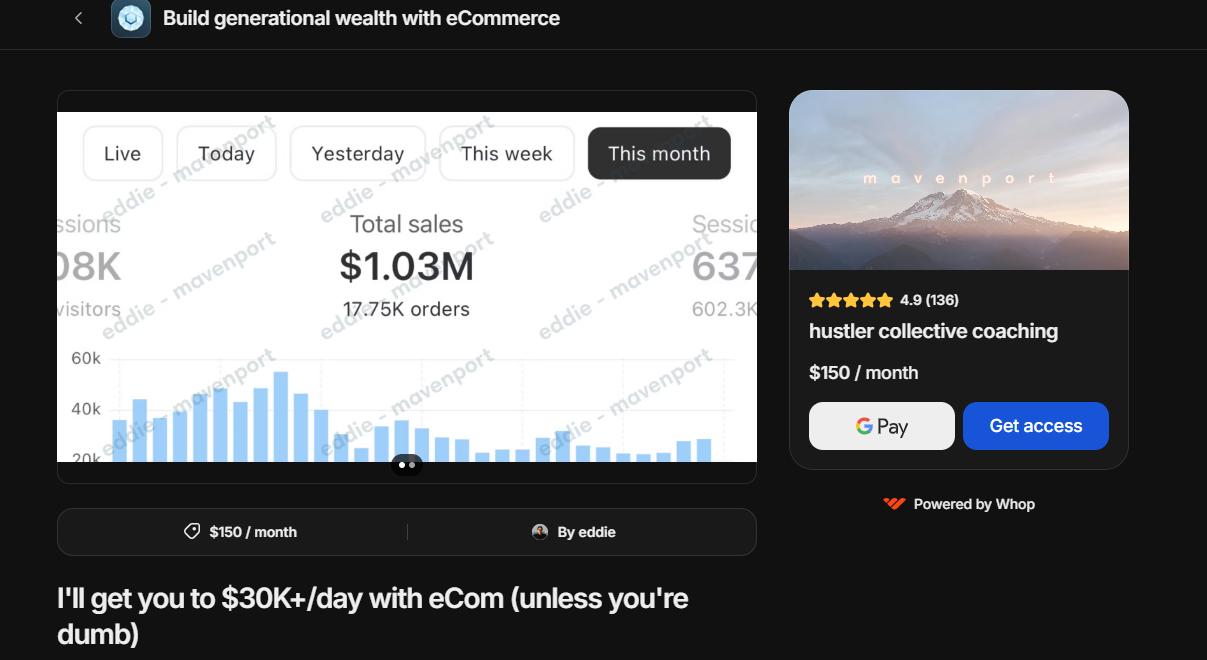
Eddie – Build generational wealth with eCommerce Mavenport – Latest Update 2026 September
$200.00 Original price was: $200.00.$40.00Current price is: $40.00.
- 24/7 Contact Support & Telegram - Ecomkevin_1
- You Can Request Any Courses
- Original Courses HD Qualite and links updated
Guaranteed Safe Checkout


Description
Eddie – Build Generational Wealth with eCommerce Mavenport: Course Overview and Review
Introduction
Building a successful eCommerce business can be an opportunity to develop long-term financial stability. However, getting started requires more than choosing products and opening an online store. Entrepreneurs also need to understand business fundamentals, customer behavior, marketing, operations, and sustainable growth.
Eddie – Build Generational Wealth with eCommerce Mavenport is a course-related search for individuals interested in eCommerce entrepreneurship and building a business with a long-term perspective. It may appeal to aspiring business owners who want to explore online selling, understand how digital commerce works, and develop a foundation for future business opportunities.
Rather than focusing only on short-term sales, the idea of generational wealth encourages a broader approach. This includes developing valuable business skills, managing resources carefully, and creating systems that can support a business over time.
If you are researching this program, understanding its general subject, potential learning areas, and suitability can help you decide whether it aligns with your entrepreneurial goals.
Course Overview
Eddie – Build Generational Wealth with eCommerce Mavenport centers on the concept of eCommerce as a potential avenue for developing long-term business assets. Online commerce allows entrepreneurs to connect with customers through digital platforms. It also creates opportunities to sell products, test business ideas, and reach markets beyond a local area.
However, operating an online business involves several interconnected responsibilities. Entrepreneurs must consider product selection, pricing, customer experience, marketing, order fulfillment, and financial management. Each area contributes to the overall performance of a business.
For anyone exploring this course, it is helpful to approach the subject with realistic expectations. Building a profitable online store takes planning, experimentation, and consistent effort. Furthermore, results depend on market demand, competition, available resources, and the decisions made throughout the process.
The program’s specific curriculum, included resources, pricing, and delivery format should be reviewed through the official course information before purchasing. This ensures that your expectations match what the program actually provides.
Understanding the eCommerce Business Model
eCommerce involves buying and selling products through online channels. These may include independent websites, established marketplaces, and other digital sales platforms.
Unlike a traditional retail business, an online store can reach customers without requiring a conventional storefront. Nevertheless, it still requires careful management, reliable processes, and a clear understanding of its target market.
For example, an entrepreneur might identify a product category with customer demand, research competing businesses, and develop a store around a specific audience. Next, the business owner would need to establish pricing, attract visitors, process orders, and provide customer support.
Each step presents different challenges. Therefore, learning the fundamentals before investing significant money can help entrepreneurs make more informed decisions.
An eCommerce education can also help beginners understand the difference between generating revenue and creating actual profit. Sales figures alone do not show whether a business is financially sustainable. Expenses, refunds, advertising costs, inventory, and other operating requirements must also be considered.
What Learners Can Expect to Learn
Although the exact lessons available in Eddie – Build Generational Wealth with eCommerce Mavenport should be confirmed with the course provider, several important areas are relevant to anyone pursuing the broader subject of eCommerce entrepreneurship.
1. Understanding Online Business Fundamentals
A solid business foundation begins with understanding how an online store operates. This includes identifying a customer group, choosing a suitable business model, and determining how products will reach buyers.
Beginners can benefit from learning how these elements work together. For instance, a product may attract attention but still struggle to generate profit if its costs are too high.
Understanding the complete business model helps entrepreneurs evaluate opportunities more carefully. As a result, they can avoid making decisions based only on trends or attractive sales figures.
2. Product Research and Market Demand
Product research is an important part of online selling. Before committing to a product, business owners should examine customer needs, competing offers, pricing, and existing demand.
Market research also helps identify potential challenges. A product with many competitors may require a different approach from one serving a specialized audience.
Additionally, entrepreneurs should consider whether a product has sustainable demand. Temporary popularity does not always translate into a reliable long-term business opportunity.
Learning to evaluate products objectively can support better purchasing decisions and reduce unnecessary experimentation.
3. Building an Online Store
An online store serves as the digital location where customers discover products and complete purchases. Its design, navigation, product descriptions, and checkout process can influence the buying experience.
A useful store should make it easy for visitors to understand what is being offered. Clear product information, transparent policies, and accessible customer support can also help establish trust.
However, building a store is only one part of the process. Business owners must also consider payment processing, shipping arrangements, returns, and ongoing maintenance.
Consequently, a well-planned store should support both customer convenience and efficient business operations.
4. Marketing and Customer Acquisition
Even a well-designed store needs a way to attract potential customers. Online businesses may use search visibility, social media, paid advertising, email marketing, and content creation to reach relevant audiences.
Each channel has different costs and requirements. Therefore, entrepreneurs should understand their target customers before deciding where to invest their marketing budget.
For example, some products may benefit from educational content, while others may depend more heavily on visual demonstrations or targeted advertising.
Testing different approaches can help businesses identify what works for their market. At the same time, measuring results is essential for understanding whether marketing expenses are producing sustainable returns.
5. Financial Planning and Profitability
Long-term business development requires careful financial management. Entrepreneurs need to understand revenue, operating expenses, cash flow, and profit margins.
For instance, a store may generate substantial sales but struggle financially because advertising, product costs, shipping, and refunds consume most of its revenue.
Budgeting can help business owners plan for these expenses. In addition, tracking financial performance makes it easier to identify problems before they become more serious.
A long-term approach also involves deciding how much money to reinvest and how much to reserve for unexpected costs. These decisions should reflect the business’s financial position rather than optimistic assumptions.
6. Developing Sustainable Business Systems
As an online business grows, its daily responsibilities can become increasingly complex. Order processing, customer communication, inventory management, and marketing all require time and attention.
Organized systems can make these activities more manageable. For example, documented procedures and appropriate software can reduce repetitive work and improve consistency.
However, automation does not remove the need for oversight. Business owners still need to monitor performance, resolve customer issues, and adjust processes when circumstances change.
Developing reliable operations can help entrepreneurs focus on strategic decisions instead of constantly reacting to routine problems.
7. Thinking About Long-Term Wealth Creation
Generational wealth involves more than earning money in the present. It generally refers to building and preserving assets that may provide value over an extended period.
An eCommerce business can potentially become one component of a broader financial strategy. Nevertheless, business ownership involves uncertainty, and no course or business model can guarantee lasting wealth.
Entrepreneurs should therefore focus on building sound financial habits, understanding risk, and creating genuine business value.
Over time, these principles may help business owners make more thoughtful decisions about reinvestment, savings, expansion, and other financial priorities.
Who Is This Course Suitable For?
Eddie – Build Generational Wealth with eCommerce Mavenport may be relevant to people exploring online business ownership and the relationship between eCommerce and long-term financial planning.
Potential audiences include:
Aspiring entrepreneurs: Individuals interested in learning about online selling and evaluating whether eCommerce fits their goals.
Beginners exploring digital commerce: People who want to understand the basic responsibilities involved in operating an online store.
Existing online sellers: Business owners who want to broaden their understanding of business development, profitability, and operational planning.
People interested in financial independence: Individuals exploring entrepreneurship as one possible part of a broader financial strategy.
Self-directed learners: People willing to research their market, test ideas, learn from mistakes, and apply business concepts consistently.
The program may be less suitable for people expecting guaranteed profits, instant results, or a completely hands-off business. Building an online business requires practical involvement, and the amount of work varies according to the chosen model.
Key Benefits of Learning About eCommerce
Understanding Business Opportunities
Learning about eCommerce can help individuals understand how digital businesses operate. This knowledge can make it easier to compare business models and evaluate opportunities.
Developing Commercial Awareness
Product demand, customer preferences, pricing, and competition all affect business performance. Understanding these factors supports more informed decision-making.
Improving Financial Awareness
A business owner’s financial knowledge can influence budgeting, pricing, reinvestment, and risk management. These skills are valuable beyond online selling.
Building a Long-Term Perspective
A focus on sustainable operations encourages entrepreneurs to look beyond immediate sales. It also highlights the importance of customer relationships, reliable processes, and responsible financial decisions.
Supporting Independent Learning
Entrepreneurship involves continuous learning. Markets change, customer expectations evolve, and business strategies sometimes need adjustment. Developing the ability to evaluate information and respond to change can be useful throughout a business journey.
These are potential benefits of learning about eCommerce generally. The specific benefits delivered by the program depend on its verified content and how learners apply the material.
Important Considerations Before Purchasing
Before enrolling in any eCommerce training program, prospective buyers should evaluate the available information carefully.
First, review the official course description and confirm exactly what is included. Check the curriculum, teaching format, access conditions, and any additional resources.
Next, consider your budget. Starting an online business may require expenses beyond education, including software, product sourcing, website maintenance, advertising, and fulfillment.
It is also important to understand the risks involved. Product demand can change, advertising campaigns may lose money, and competition can affect profit margins. Even careful planning cannot eliminate these uncertainties.
Finally, consider your current experience and learning preferences. Some people benefit from structured instruction, while others prefer books, practical experimentation, or a combination of resources.
Taking time to evaluate these factors can help you make a purchasing decision based on your needs rather than unrealistic expectations.
Frequently Asked Questions
What is Eddie – Build Generational Wealth with eCommerce Mavenport?
It is a course-related offering associated with eCommerce entrepreneurship and the broader concept of building long-term wealth through business ownership. Prospective buyers should consult the official course information for a precise description of its curriculum and included materials.
Is this course suitable for beginners?
It may interest beginners who want to explore online business opportunities. However, its actual difficulty level and assumed prior knowledge should be confirmed with the provider before enrolling.
Do I need previous eCommerce experience?
Previous experience is not necessarily required to begin learning about eCommerce. Nevertheless, practical knowledge of online selling, customer service, and financial management can be useful when applying business concepts.
Can eCommerce help build generational wealth?
An eCommerce business can potentially become a valuable financial asset. However, outcomes depend on profitability, market conditions, business management, and many other factors. There is no guarantee that an online store will produce lasting wealth.
Does the course guarantee financial results?
Financial results should never be assumed or guaranteed. Business performance depends on numerous variables, including the product, competition, available capital, marketing decisions, and execution.
What should I verify before enrolling?
Review the course curriculum, instructor information, delivery format, access terms, pricing, refund policy, and any additional resources. Confirm these details directly with the provider because they may vary.
Is eCommerce a completely passive income model?
Generally, no. Online stores require decisions about marketing, customer service, operations, finances, and product management. Some processes can be automated, but oversight and ongoing work are usually necessary.
What additional expenses should I consider?
Depending on the business model, expenses may include website hosting, platform subscriptions, inventory, product samples, shipping, payment processing, advertising, and customer support. Planning for these costs is important before launching a store.
Final Thoughts
Eddie – Build Generational Wealth with eCommerce Mavenport is relevant to entrepreneurs researching online commerce and the possibility of building long-term financial assets through business ownership.
The broader subject offers valuable areas to explore, including product research, online store management, customer acquisition, financial planning, and operational efficiency. Together, these areas can help aspiring entrepreneurs develop a more complete understanding of what running an online business involves.
However, success requires more than information alone. It also depends on practical execution, realistic budgeting, careful research, and the ability to adapt when circumstances change.
Before purchasing, review the program’s verified details and compare them with your goals, experience, and available resources. With a clear understanding of the commitment involved, you can decide whether this learning opportunity fits your plans for exploring eCommerce entrepreneurship.
Reviews
There are no reviews yet.