Callan Faulkner – A2A AI Quick Start Lab
$997.00 Original price was: $997.00.$40.00Current price is: $40.00.
- 24/7 Contact Support & Telegram - Ecomkevin_1
- You Can Request Any Courses
- Original Courses HD Qualite and links updated
Guaranteed Safe Checkout

Description
Callan Faulkner – A2A AI Quick Start Lab
Build Practical AI Employees for Your Business
Artificial intelligence is changing how businesses operate. However, knowing about AI is different from knowing how to use it effectively. Many business owners use ChatGPT or other AI tools every day. Yet they still spend hours handling repetitive tasks, organizing information, writing documents, and managing workflows manually.
Callan Faulkner – A2A AI Quick Start Lab is designed to help bridge that gap. It introduces a practical approach to using AI as a working part of your business. Instead of treating AI as another chatbot, the training explores how to build AI employees that can support specific responsibilities and recurring tasks.
The program focuses on practical implementation. You learn how to identify tasks that could benefit from AI, establish a strong foundation, create reusable skills, and connect AI tools with your everyday business applications.
Whether you are an entrepreneur, freelancer, consultant, or business professional, this training provides a structured starting point for making AI more useful in your daily work.
What Is Callan Faulkner – A2A AI Quick Start Lab?
The A2A AI Quick Start Lab is a self-paced training experience based on the foundations taught in Callan Faulkner’s Automate to Accelerate (A2A) approach.
Its central idea is simple: identify repetitive work, organize it into clear processes, and use AI to help carry out those responsibilities.
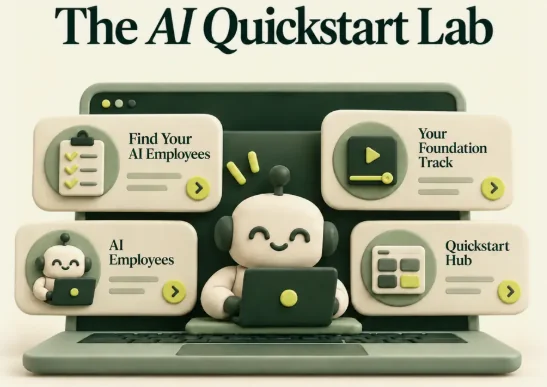
The program brings together four main areas:
- Finding opportunities to create your first AI employees.
- Building essential AI and prompting skills.
- Understanding the different levels of an AI employee.
- Applying ready-to-use prompts and skills to everyday business tasks.
Rather than focusing only on theory, the training encourages you to work with your own business activities. As a result, you can connect what you learn with real tasks and processes.
It also introduces tools such as Claude, ChatGPT, Notion, Granola, and Wispr Flow. These tools can support different parts of an AI-powered workflow.
What You Can Learn
1. Find Your First AI Employees
Before building an AI employee, you need to understand which tasks are worth delegating.
The training introduces a method for reviewing your previous AI conversations. A dedicated prompt helps identify repeated requests and recurring work. It then suggests five potential AI employees based on those patterns.
You can use this process to explore:
- Which tasks you regularly repeat.
- Where AI could support your existing workflow.
- Which responsibilities may be suitable for automation.
- How much time certain tasks could potentially save.
- Which AI employee may be the best starting point.
This approach helps you begin with your actual working habits. Therefore, you do not need to guess which automation idea to pursue first.
The process also provides guidance for building your first AI employee. This makes it easier to move from identifying an opportunity to exploring a practical solution.
2. Build a Strong Foundation in AI
A useful AI workflow starts with the right foundation. You need to understand how your tools work and how to communicate your requirements clearly.
The foundation track includes 18 short lessons arranged in a structured sequence. Most videos are under ten minutes. In addition, lessons include practical activities based on your own work and quick checks to help you review your progress.
Topics include:
- Setting up Claude for practical use.
- Writing clearer and more effective prompts.
- Improving an unsatisfactory AI response.
- Working with ChatGPT.
- Understanding tools such as Notion and Granola.
- Exploring Wispr Flow for voice-based workflows.
- Applying AI tools to everyday business activities.
You also learn how to improve an AI response without starting the entire conversation again. This is useful when an answer needs clarification, correction, or additional context.
Consequently, you can develop a more consistent approach to using AI rather than relying on random prompts.
3. Understand the Four Levels of an AI Employee
One of the central concepts in Callan Faulkner – A2A AI Quick Start Lab is the four-level framework for developing an AI employee.
This framework helps explain how an AI assistant can become more useful when it has the right information, instructions, connections, and schedule.
Level 1: Projects
A Project gives an AI assistant information about your business or a specific area of work. This context helps the assistant understand what it is working on.
For example, you may organize information about your company, customers, services, or internal processes. This can reduce the need to explain the same background in every conversation.
Level 2: Skills
A skill provides reusable instructions for a particular task. Instead of repeatedly explaining how something should be done, you can create a structured process.
For instance, a skill might help prepare meeting summaries, organize information, or follow a consistent writing process.
This makes repeated work easier to manage. Moreover, it helps create more consistent outputs.
Level 3: Connectors
Connectors allow an AI assistant to interact with external tools and applications. The training introduces the concept of connecting Claude with platforms such as Notion, Slack, and email.
These connections can help bring AI into the applications you already use. Therefore, your workflow does not have to remain limited to a standalone chat window.
Level 4: Schedules
A schedule allows an AI employee to run a task at a planned time. This introduces another level of automation because you do not need to manually initiate every recurring activity.
Together, these four levels provide a framework for thinking about AI employees. You also work towards building your first Project, skill, and connection.
4. Explore the AI Starter Kit
The program includes a Starter Kit with 13 ready-to-use prompts and skills. These resources are designed around common business and administrative activities.
They provide examples of how AI can support work that often takes time and attention.
The examples include:
- Meeting recaps: Organize meeting transcripts into decisions, responsibilities, and deadlines.
- Client follow-ups: Turn call transcripts into structured recap emails.
- Project planning: Convert meeting discussions into project plans with phases, owners, and dates.
- Action items: Identify tasks and commitments from recorded conversations.
- Social media content: Repurpose podcast or webinar recordings into social media content.
- Newsletter writing: Turn voice notes into newsletter drafts.
- Podcast content: Find useful ideas and excerpts from existing recordings.
- Standard operating procedures: Convert explanations of a process into documented SOPs.
- Process documentation: Create reusable instructions for tasks that are often explained repeatedly.
- Contract review support: Identify clauses that may need closer attention in vendor agreements.
- Business context: Prepare information about your business, brand voice, and customers for more relevant AI responses.
- Fact checking: Review claims before using them in business communications.
- Prompt improvement: Evaluate prompts and identify areas that could be improved.
Each resource includes a prompt to copy, a practice step, and three checks. As a result, you can explore the resources using your own work instead of relying only on generic examples.
Who Should Take This AI Training?
Callan Faulkner – A2A AI Quick Start Lab is suitable for people who want to use AI more practically in their professional or business activities.
Business owners and entrepreneurs
If you manage a business, you probably handle many recurring responsibilities. This training can help you identify tasks that may be supported by AI and explore ways to organize them into repeatable workflows.
Freelancers and consultants
Freelancers often manage client communication, project planning, content creation, and administrative work. AI skills can help make these activities more structured.
Marketing professionals
Marketing teams regularly work with content, research, planning, and reporting. The training’s examples offer ideas for applying AI to these activities.
Agency owners and teams
Agencies often repeat similar processes across different clients. Learning about reusable AI skills and business context can help teams explore more consistent workflows.
Professionals new to AI automation
You do not need to begin with advanced automation knowledge. The foundation track starts with essential setup and prompting concepts before introducing the AI employee framework.
Regular AI users
If you already use ChatGPT or Claude, you may want to move beyond individual conversations. This program explores how to turn repeated AI tasks into more organized processes.
Key Benefits of the A2A AI Quick Start Lab
There are several practical reasons to explore this training.
- A structured learning path: The lessons follow an organized sequence, helping you develop foundational skills before moving into more advanced concepts.
- Practical exercises: You work with your own tasks and business activities throughout the learning process.
- Reusable prompts: The Starter Kit provides resources that you can adapt for recurring responsibilities.
- Better prompting: Learn how to communicate instructions more clearly and improve AI-generated responses.
- AI workflow development: Understand how Projects, skills, connectors, and schedules fit together.
- Tool familiarity: Explore several AI and productivity applications used in modern workflows.
- Less repetitive setup: Reusable business context and instructions can reduce the need to explain the same information repeatedly.
- Flexible learning: The Quick Start Lab is presented as self-paced training, without scheduled live calls.
Most importantly, the program encourages you to focus on practical applications. You can start by identifying one recurring task and then explore how AI might support it.
Why Learn About AI Employees?
AI tools are becoming increasingly useful across business operations. However, simply having access to more tools does not automatically improve productivity.
The real opportunity comes from understanding how to apply them to specific responsibilities.
For example, a business owner might use AI to organize meeting notes. A marketing professional might turn recorded discussions into content drafts. Similarly, an agency could document a repeated client process and create reusable instructions for it.
These are different tasks, but they share one principle: clear instructions and organized information make AI more useful.
The AI employee framework provides a way to think about these applications. It helps you move from isolated prompts towards workflows that have context, repeatable skills, useful connections, and scheduled activities.
Furthermore, the Starter Kit gives you examples that you can adapt to your own requirements.
Frequently Asked Questions
What is Callan Faulkner – A2A AI Quick Start Lab?
It is a self-paced AI training program based on the foundations of Callan Faulkner’s A2A approach. It covers AI employee discovery, foundational AI skills, a four-level AI employee framework, and a collection of practical prompts and skills.
Is this course suitable for beginners?
The foundation track starts with essential setup and prompting lessons. Therefore, it can be a useful starting point for people who want to develop practical AI skills. Some familiarity with using digital tools may make the exercises easier to follow.
What tools are covered?
The training introduces Claude, ChatGPT, Notion, Granola, and Wispr Flow. It also explores connecting Claude with applications such as Notion, Slack, and email.
How many lessons are included?
The foundation track contains 18 short lessons. Most videos are under ten minutes, and the lessons include practical activities and progress checks.
What is included in the Starter Kit?
The Starter Kit includes 13 ready-to-use prompts and skills. Examples cover meeting recaps, project planning, newsletters, podcast content, SOPs, vendor contracts, and prompt improvement.
What is an AI employee?
An AI employee is a way of organizing AI around a particular responsibility or recurring task. The framework covered in this training uses Projects, skills, connectors, and schedules to develop more capable AI workflows.
Does the training require coding?
The published course outline focuses on AI setup, prompting, reusable skills, connections, and workflows. It does not describe the program as a coding-focused course.
Can I learn at my own pace?
Yes. The AI Quick Start Lab is described as self-paced training without live calls. This allows learners to work through the lessons according to their own schedule.
Who is this training best suited for?
It is particularly relevant to entrepreneurs, business owners, consultants, freelancers, agency teams, and professionals who want to apply AI to recurring work.
Start Building More Useful AI Workflows
Learning to use AI effectively is about more than writing better prompts. It is about understanding your work, identifying repeated responsibilities, and creating systems that make everyday tasks easier to manage.
Callan Faulkner – A2A AI Quick Start Lab provides a structured introduction to this approach. With 18 foundation lessons, a four-level AI employee framework, and 13 practical prompts and skills, it offers several starting points for applying AI to real business activities.
If you want to move beyond basic AI conversations and explore more organized, reusable workflows, this training is a practical place to begin.
Explore the concepts, apply the exercises to your own work, and start discovering where AI can become a more useful part of your business.
Reviews
There are no reviews yet.