
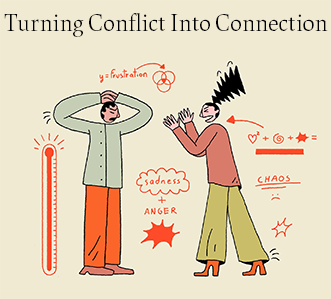
Esther Perel – Turning Conflict Into Connection
$99.00 Original price was: $99.00.$25.00Current price is: $25.00.
- 24/7 Contact Support & Telegram - Ecomkevin_1
- You Can Request Any Courses
- Original Courses HD Qualite and links updated
Guaranteed Safe Checkout


Description
Esther Perel – Turning Conflict Into Connection
Conflict is a natural part of every relationship. Whether it happens between romantic partners, family members, friends, or people who work closely together, disagreements are unavoidable. The real challenge is learning how to navigate those disagreements without becoming trapped in the same arguments, reactions, and patterns.
Esther Perel – Turning Conflict Into Connection is a self-paced relationship course designed to help you understand conflict differently. Rather than simply trying to eliminate arguments, the course explores how conflict can become an opportunity for greater understanding, communication, repair, and connection.
Created by renowned psychotherapist and bestselling author Esther Perel, the course focuses on recognizing recurring conflict patterns, understanding your own reactions, identifying what is really underneath an argument, and developing new ways to respond when disagreements arise.
About Turning Conflict Into Connection
Many arguments appear to be about one specific issue, but the deeper problem can be something else entirely. A disagreement about chores, communication, money, boundaries, family, or attention may represent deeper concerns about security, recognition, autonomy, trust, or connection.
Turning Conflict Into Connection encourages you to look beyond the surface of an argument and examine the patterns that repeatedly bring you and another person into conflict.
The course is built around the idea that you cannot always control another person’s behavior, but you can become more aware of your own responses and your contribution to a relational pattern. By understanding those patterns, you can begin making different choices.
Instead of automatically shutting down, becoming defensive, escalating an argument, or avoiding difficult conversations, you can learn to pause, reflect, and create new possibilities for communication.
What You Can Expect to Learn
Esther Perel – Turning Conflict Into Connection explores several important aspects of relationship conflict and communication.
1. Understand the Choreography of Conflict
Conflict does not happen in isolation. One person’s reaction can trigger another person’s response, creating a predictable cycle that becomes increasingly difficult to interrupt.
This part of the course explores the difference between constructive and destructive conflict and introduces different ways people tend to respond during disagreements. Understanding these patterns can help you recognize what is happening while a conflict is unfolding.
2. Discover the Real Reasons Behind Arguments
Sometimes what people are fighting about is not actually what they are fighting for.
The course encourages you to look beneath the immediate subject of an argument and consider the deeper dimensions influencing the disagreement. This perspective can make it easier to understand why seemingly small situations can produce surprisingly strong emotional reactions.
3. Recognize Your Own Reactions
People respond to conflict differently. Some people become more vocal and confrontational. Others withdraw, become quiet, avoid difficult conversations, or emotionally distance themselves.
Turning Conflict Into Connection helps you become more aware of your own conflict responses and the patterns that may repeatedly appear in your relationships.
Developing this awareness can create space between the initial emotional reaction and the response that follows, giving you more opportunity to make a different choice.
4. Break Repetitive Conflict Patterns
One of the most frustrating experiences in a relationship is having the same argument repeatedly without reaching a meaningful resolution.
Instead of simply trying to win an argument, this course encourages you to step back and observe the pattern itself. By identifying the sequence of reactions and responses, you can begin looking for alternative ways to approach the same situation.
5. Learn Strategies for De-Escalation
When emotions become intense, conversations can quickly become more damaging than productive. Learning how to de-escalate can create the space needed to think more clearly and communicate more effectively.
The course introduces approaches for stepping out of habitual reactions and creating new options during difficult conversations.
6. Understand Reconciliation and Repair
Healthy relationships are not relationships without conflict. They are relationships in which people can work through disagreements and repair the damage that conflict can sometimes create.
Turning Conflict Into Connection explores reconciliation, accountability, apology, and repair as important parts of navigating relationship difficulties.
The goal is not simply to avoid disagreement. It is to develop a healthier relationship with disagreement itself.
Course Curriculum
The current course curriculum is organized around four core modules:
- The Choreography of Conflict – Explore constructive versus destructive fighting and different conflict styles.
- The Real Reasons You Fight – Look beyond the surface issue and identify deeper dimensions behind recurring disagreements.
- Creating New Opportunities and Options – Explore communication and conflict patterns and strategies for de-escalation.
- How to Reconcile and Repair – Learn approaches to apology, reconciliation, and repairing relationships after conflict.
The course also includes video lessons, guided exercises, an interactive workbook, prompts, and conversation catalysts designed to help turn reflection into practical action.
Who Is Esther Perel – Turning Conflict Into Connection For?
This course can be useful for individuals and couples who want to develop stronger relationship and communication skills.
Couples Seeking Better Connection
Even couples who rarely describe themselves as people who “fight” experience disagreements. The course provides a framework for understanding those disagreements and responding to them more intentionally.
People Stuck in Repeating Arguments
If you repeatedly find yourself having the same argument, responding in the same way, or reaching the same frustrating outcome, the course can help you examine the pattern rather than focusing only on the latest disagreement.
Individuals Working on Personal Growth
You do not necessarily need your partner to participate. The course can also be approached as an opportunity to understand your own reactions, communication habits, and role in relationship dynamics.
Anyone Interested in Relationship Skills
You do not have to be experiencing a major relationship problem to benefit from learning about conflict. Understanding how disagreements work can help you become more intentional about communication and connection.
Why Conflict Can Become an Opportunity for Connection
It is easy to think that a good relationship is one in which people always agree. In reality, two people can care deeply about each other while having different opinions, needs, expectations, histories, and perspectives.
The challenge is learning how to manage those differences.
Esther Perel’s approach focuses on moving away from the idea that every disagreement has to produce a winner and a loser. Instead, conflict can become an opportunity to understand another person’s perspective while also becoming more aware of your own.
This shift can change the way you approach difficult conversations. Rather than immediately asking, “How do I win this argument?” you can begin asking questions such as, “What is really happening here?” or “What pattern are we repeating?”
Learn at Your Own Pace
Turning Conflict Into Connection is designed as a self-paced course. It combines video lessons with exercises and workbook material, allowing learners to reflect on the concepts and apply them to their own relationships.
The official course information recommends taking time to work through the lessons and accompanying exercises rather than simply consuming the material as entertainment. Learners can work through the material individually or use it as a shared learning experience with a partner.
The complete course is estimated to take approximately 5–10 hours when the videos and exercises are completed.
About Esther Perel
Esther Perel is a renowned psychotherapist and New York Times bestselling author known for her work exploring modern relationships, intimacy, desire, communication, and connection.
She is also known for the podcast Where Should We Begin?, where she explores complex relationship dynamics and interpersonal experiences.
Through her books, podcasts, courses, and public work, Esther Perel has developed a distinctive approach to understanding the complexities of modern relationships and the tension between connection, individuality, security, and freedom.
Key Benefits of the Course
- Develop greater awareness of your personal conflict patterns.
- Understand why recurring arguments can become repetitive.
- Explore what may be underneath the surface of disagreements.
- Recognize different reactions to conflict.
- Learn approaches for de-escalating difficult conversations.
- Explore ways to communicate during disagreements more intentionally.
- Develop greater awareness of your role in relationship patterns.
- Learn about reconciliation, accountability, apology, and repair.
- Use guided exercises and prompts to reflect on your own experiences.
- Build greater relational awareness and communication skills.
Frequently Asked Questions
What is Esther Perel – Turning Conflict Into Connection?
Turning Conflict Into Connection is a self-paced relationship course by Esther Perel focused on understanding conflict, recognizing recurring patterns, improving responses to disagreements, and developing skills for reconciliation and repair.
Is this course suitable for individuals?
Yes. The course can be completed individually and does not require a partner to participate. It is designed to help individuals examine their own reactions and develop greater capacity for productive conflict.
Can couples take the course together?
Yes. The course can be used by couples who want to explore conflict and communication together. Working through the exercises can provide opportunities for reflection and conversation.
Do I receive one-on-one therapy or advice from Esther Perel?
No. This is a self-paced course. Esther Perel does not provide real-time therapy or individual feedback to course participants.
How long does the course take?
The official course information states that completing the videos and exercises takes approximately 5–10 hours, although learners can choose a pace that works for them.
Does the course focus on eliminating conflict?
No. The focus is on understanding and navigating conflict more effectively. Disagreements are a natural part of relationships, and the course explores how people can respond to conflict in more productive ways.
What materials are included?
The course includes video lessons, exercises, an interactive workbook, prompts, and conversation catalysts designed to support reflection and practical application.
Start Turning Conflict Into Connection
Every relationship has moments of disagreement. The difference is often found not in whether conflict happens, but in how people respond when it does.
Esther Perel – Turning Conflict Into Connection offers a thoughtful framework for understanding those moments, recognizing repeated patterns, examining your own reactions, and exploring new ways to communicate and repair.
Whether you are working through recurring disagreements, looking to strengthen an existing relationship, or simply interested in developing better relationship skills, this course provides an opportunity to look at conflict from a different perspective.
Instead of seeing every disagreement as something that must be avoided or won, you can begin to see conflict as something that can be understood, navigated, and potentially transformed into deeper connection.
Reviews
There are no reviews yet.