
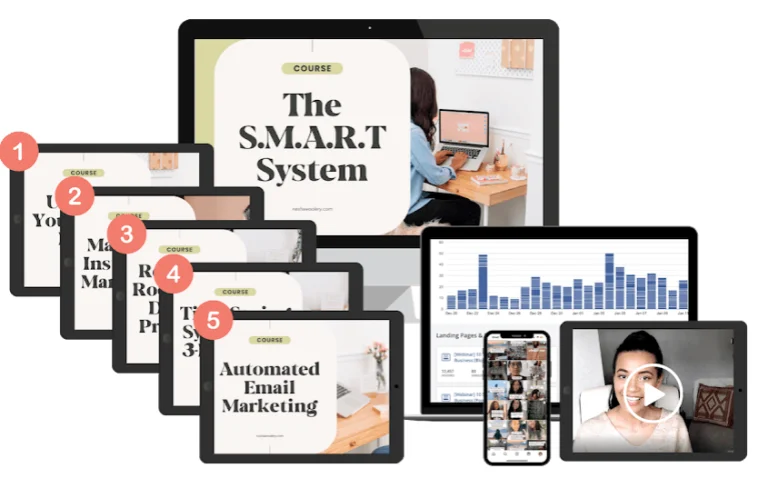
Nesha Woolery – The S.M.A.R.T System
$797.00 Original price was: $797.00.$40.00Current price is: $40.00.
- 24/7 Contact Support & Telegram - Ecomkevin_1
- You Can Request Any Courses
- Original Courses HD Qualite and links updated
Guaranteed Safe Checkout


Description
Nesha Woolery – The S.M.A.R.T System
Discover a Smarter Way to Approach Your Goals and Productivity
Nesha Woolery – The S.M.A.R.T System is a practical productivity and goal-setting program designed around a structured approach to making your goals more clear, actionable, and achievable.
If you often find yourself creating goals but struggling to turn them into consistent action, a structured system can make a significant difference. Instead of simply deciding what you want to accomplish, the S.M.A.R.T System focuses on creating a more organized way to define your objectives, plan your actions, and stay focused on meaningful progress.
For entrepreneurs, freelancers, creators, professionals, and anyone trying to become more productive, having a system can be more useful than simply relying on motivation.
Nesha Woolery – The S.M.A.R.T System provides a framework for approaching goals and productivity in a more intentional way.
What Is Nesha Woolery – The S.M.A.R.T System?
The S.M.A.R.T System by Nesha Woolery is a training resource focused on structured goal setting and productivity.
The central idea behind a SMART-style approach is to move away from vague goals and instead create objectives that are easier to understand, track, and work toward.
For example, instead of saying:
“I want to become more productive.”
you can turn the idea into a clearer objective with a defined outcome and a plan for taking action.
This type of structured thinking can help you understand exactly what you are trying to accomplish and what steps you need to take.
The system can be particularly useful if you have many responsibilities competing for your attention and need a more organized method for deciding what deserves your time and energy.
Why Goal Setting Systems Matter
Having a goal is easy.
Actually working toward that goal consistently is much harder.
Many people set goals at the beginning of a month or year but eventually lose track of them. Sometimes the problem isn’t a lack of ambition. The problem is that the goal is too broad, unclear, or difficult to measure.
Consider these two goals:
Goal A:
“I want to grow my online business.”
Goal B:
“I want to increase my website’s organic traffic by improving a specific group of pages and consistently publishing useful content.”
The second goal gives you something more concrete to work toward.
A structured goal-setting system can help transform ideas into actionable objectives.
That’s where Nesha Woolery – The S.M.A.R.T System can become useful.
What You Can Learn From The S.M.A.R.T System
The program is designed around a structured approach to goals and productivity. Depending on your objectives, the framework can help you think more carefully about what you want to accomplish and how you will approach it.
Potential areas of application include:
- Setting clearer goals
- Organizing priorities
- Turning larger objectives into actionable plans
- Creating more measurable outcomes
- Improving productivity
- Establishing greater focus
- Planning your work more intentionally
- Tracking progress
- Reducing ambiguity around your objectives
- Creating a structured approach to accomplishing important tasks
Rather than treating productivity as simply “doing more,” a structured system can help you focus on doing the right things.
Who Is Nesha Woolery – The S.M.A.R.T System For?
This type of productivity and goal-setting training can be relevant to a wide range of people.
Entrepreneurs
Business owners often have dozens of ideas and responsibilities competing for their attention. A structured goal-setting approach can help entrepreneurs turn broad business ambitions into more manageable objectives.
For example, instead of simply deciding to “grow the business,” you could define specific business objectives and determine the actions required to pursue them.
Freelancers
Freelancers often manage multiple clients, projects, deadlines, and personal responsibilities.
A structured system can help create greater clarity around priorities and project goals.
Creators
Content creators, designers, writers, educators, and other creative professionals can benefit from having a system for turning ideas into actionable plans.
Professionals
People working in traditional careers can also use goal-setting frameworks when working toward professional development, project objectives, or personal productivity improvements.
Students
Students can apply structured goals to study plans, assignments, exams, and long-term academic objectives.
Anyone Who Struggles With Consistency
If you frequently create goals but struggle to maintain momentum, learning a structured approach may help you think differently about how you set and pursue those goals.
Key Benefits of a Structured SMART Approach
1. Greater Clarity
One of the biggest advantages of structured goal setting is clarity.
Instead of having a general idea of what you want, you can define the outcome more precisely.
This makes it easier to understand what you’re working toward.
2. Better Focus
When you have too many priorities, it can become difficult to decide what to work on first.
A structured approach can help you identify the objectives that matter most and organize your efforts around them.
3. Easier Progress Tracking
A goal becomes much easier to evaluate when you can identify what progress looks like.
Tracking allows you to determine whether your current actions are moving you toward your desired outcome.
4. More Action-Oriented Planning
Goals are only useful when they lead to action.
A structured framework encourages you to think about the steps required to move from your current situation toward the desired result.
5. Better Organization
Productivity isn’t simply about completing a large number of tasks.
It’s also about organizing your time and effort around meaningful priorities.
Using The S.M.A.R.T System in an Online Business
If you run an online business, a structured goal-setting system can be applied to many areas of your work.
For example, suppose you sell digital products or online courses.
Instead of setting the goal:
“I want more sales.”
you could create a much clearer objective around:
- Website traffic
- Conversion rates
- Product-page improvements
- Email subscribers
- Content production
- Customer acquisition
- Organic search visibility
- Promotional campaigns
You can then break the larger business objective into smaller actions.
For example:
Business objective
↓
Increase organic traffic
↓
Research target keywords
↓
Improve existing pages
↓
Publish useful supporting content
↓
Build internal links
↓
Track Search Console performance
↓
Improve pages based on results
This transforms a broad ambition into a sequence of actions.
Using SMART Goals for Productivity
A productivity goal shouldn’t simply be:
“I need to work harder.”
Instead, think about:
What exactly do I need to accomplish?
How will I know whether I succeeded?
What actions are necessary?
When should the objective be completed?
How does this goal connect with my larger priorities?
This way of thinking can make productivity more intentional.
Turning Big Goals Into Smaller Objectives
Large goals can feel overwhelming.
Imagine someone wants to build an online business.
That’s a huge objective.
Instead of trying to accomplish everything simultaneously, they could divide the goal into smaller areas:
Website
Build and optimize the website.
Products
Create or organize the product catalog.
Marketing
Develop marketing channels.
SEO
Research keywords and improve search visibility.
Content
Create useful educational content.
Sales
Improve conversion opportunities.
Analytics
Measure traffic and revenue.
Each area can then have its own objectives.
This makes a large goal easier to approach.
The Importance of Measuring Progress
One of the biggest differences between a vague goal and a structured goal is the ability to evaluate progress.
Imagine saying:
“I want to improve my productivity.”
How do you know whether you’ve succeeded?
Now imagine defining specific outcomes and tracking them.
You can compare your current performance against your desired result and make adjustments where necessary.
This creates a feedback loop:
Goal → Action → Measurement → Evaluation → Improvement
That cycle can be useful in both personal productivity and business.
Creating a More Intentional Workflow
Productivity systems aren’t necessarily about filling every minute of your day.
Instead, the goal should be to make your time more intentional.
A structured system can encourage you to ask:
- What is most important?
- What needs to happen first?
- What can wait?
- What does success look like?
- How will I measure progress?
- What actions should I take next?
These questions can help reduce the feeling of constantly being busy without making meaningful progress.
Pros of Nesha Woolery – The S.M.A.R.T System
Pros
- Provides a structured way to think about goals.
- Can help make objectives clearer.
- Useful for organizing priorities.
- Applicable to personal and professional goals.
- Can be useful for entrepreneurs and freelancers.
- Encourages measurable progress.
- Helps turn broad ideas into actionable objectives.
- Can be adapted to different types of projects and goals.
Things to Consider
Cons
- A productivity framework cannot replace consistent execution.
- Different people may need different productivity systems.
- Setting goals alone does not guarantee that they will be achieved.
- The effectiveness of any framework depends on how consistently you apply it.
The most important part is not simply learning a productivity framework.
It’s actually using the framework repeatedly.
Who Should Consider The S.M.A.R.T System?
You may find this type of training particularly relevant if you:
- Have difficulty defining clear goals.
- Start projects but struggle to finish them.
- Have too many competing priorities.
- Want a more structured productivity process.
- Run an online business.
- Work independently.
- Manage multiple projects.
- Want to improve your planning.
- Need a clearer way to measure progress.
- Want to become more intentional with your time.
Who May Not Need It?
This type of training may not be necessary for someone who already has a productivity system that works consistently and produces the desired results.
It’s also important to remember that a framework is a tool—not a guarantee.
The results ultimately depend on your own implementation, consistency, and circumstances.
How to Apply the S.M.A.R.T Approach
A simple way to put structured goal setting into practice is to start with one important objective.
Step 1: Identify the Goal
Clearly define what you want to accomplish.
Step 2: Clarify the Outcome
Determine what successful completion actually looks like.
Step 3: Determine How You Will Measure Progress
Choose appropriate indicators that help you understand whether you’re moving in the right direction.
Step 4: Create Action Steps
Break the objective into manageable tasks.
Step 5: Establish a Timeline
Determine when you want to review or complete the objective.
Step 6: Review
Regularly evaluate what is working and what needs to change.
This creates a repeatable process rather than relying entirely on motivation.
Frequently Asked Questions
What is Nesha Woolery – The S.M.A.R.T System?
Nesha Woolery – The S.M.A.R.T System is a productivity and goal-setting resource designed to help users approach their objectives in a more structured and actionable way.
Who is Nesha Woolery?
Nesha Woolery is associated with productivity and organizational training, with a focus on helping people develop more structured approaches to their work and goals.
What can I learn from The S.M.A.R.T System?
The system focuses on structured goal setting, organization, planning, measurable objectives, and taking actionable steps toward important goals.
Is The S.M.A.R.T System suitable for beginners?
A structured goal-setting approach can be useful for beginners because it provides a framework for thinking about objectives and planning actions.
Can entrepreneurs use The S.M.A.R.T System?
Yes. Entrepreneurs can apply structured goal setting to areas such as business growth, marketing, product development, customer acquisition, and productivity.
Can freelancers use this productivity system?
Yes. Freelancers can apply goal-setting principles to project planning, client work, deadlines, professional development, and business administration.
Can I use SMART goals for business?
Yes. SMART-style objectives can be applied to many business activities, including marketing, sales, SEO, product development, and operational goals.
Does setting SMART goals guarantee success?
No. A goal-setting framework provides structure, but achieving the objective still requires appropriate planning, execution, consistency, and adaptation.
How can I apply SMART goals to my online business?
You can use structured goals for areas such as website traffic, sales, content production, customer acquisition, conversion rates, and product development.
Is The S.M.A.R.T System only for business owners?
No. Goal-setting and productivity principles can be applied to professional, personal, academic, and business objectives.
Final Verdict
Nesha Woolery – The S.M.A.R.T System is a productivity and goal-setting resource for people who want a more structured approach to defining objectives and turning them into actionable plans.
Its greatest potential value is in helping you move from vague intentions to clearer objectives, measurable progress, and organized action.
Whether you’re an entrepreneur building an online business, a freelancer managing multiple projects, a professional working toward career goals, or simply someone looking for a more structured way to approach your objectives, a SMART-style framework can provide a useful foundation.
The key is implementation. A productivity system becomes valuable when you consistently use it to decide what matters, define what you want to accomplish, take action, measure progress, and adjust your approach.
If you’re looking for a structured approach to goal setting, productivity, planning, and achieving clearer objectives, Nesha Woolery – The S.M.A.R.T System may be a useful resource to explore.
Reviews
There are no reviews yet.