Nick Milo – Linking Your AI
$299.00 Original price was: $299.00.$40.00Current price is: $40.00.
- 24/7 Contact Support & Telegram - Ecomkevin_1
- You Can Request Any Courses
- Original Courses HD Qualite and links updated
Guaranteed Safe Checkout

Description
Nick Milo – Linking Your AI Review: Build a Future-Proof AI Assistant With Obsidian
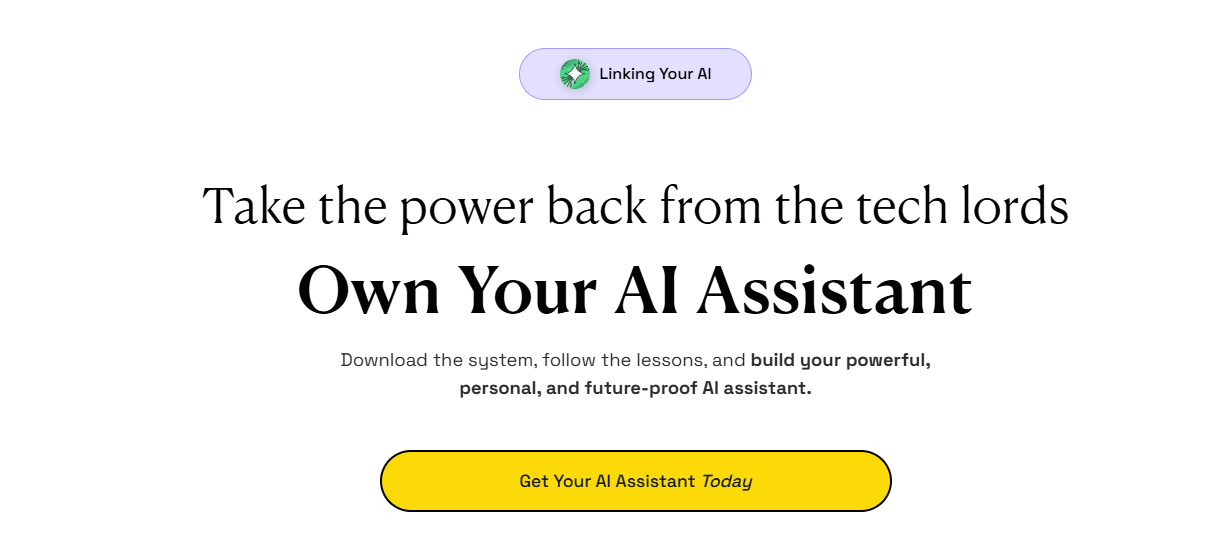
If you are looking for a better way to combine AI, Obsidian, personal knowledge management, and your own notes, Nick Milo – Linking Your AI is a course worth exploring. Instead of focusing only on AI prompts or short-term tricks, the program teaches a broader system for building an AI assistant around your own information, workflows, and thinking.
Created by Nick Milo of Linking Your Thinking, Linking Your AI is designed around the idea of creating an AI Operating System (AI OS) that sits between your notes and your AI tools. The goal is to make AI more useful because it has a better understanding of your work, preferences, projects, and knowledge.
The approach is particularly interesting for people already using Obsidian or another local-first knowledge-management system.
What Is Nick Milo – Linking Your AI?
Linking Your AI is a self-paced course focused on building a personalized AI assistant. The official program currently includes a downloadable LYAI Starter Vault, an AI OS, an interactive AI Autobuilder, eight included systems, more than three hours of self-paced lessons, permission controls, and one year of access to updated lessons. The listed price is $299 as a one-time investment, with payment-plan options potentially available at checkout.
The central concept is different from simply opening ChatGPT or Claude and asking questions.
Instead, you build a structured layer of instructions, skills, procedures, notes, and workflows that helps your AI understand how you work.
This makes Linking Your AI especially relevant to people interested in an AI PKM system, an Obsidian AI workflow, or a more personalized version of a digital second brain.
How Linking Your AI Works
One of the strongest ideas behind the course is the AI OS framework.
Rather than making your AI assistant completely dependent on one particular AI application, the system is designed to be more portable. The official course currently demonstrates Claude, particularly Claude Cowork, but the creators state that the principles are intended to work with other AI tools as they evolve.
The course also teaches a three-part approach to engaging with AI:
Imagine – use AI to explore possibilities and ideas.
Discern – critically evaluate what AI produces rather than automatically accepting its answers.
Integrate – bring useful insights back into your notes, work, and personal knowledge system.
This philosophy is important because the course is not simply about getting AI to do everything for you. Nick Milo emphasizes keeping human judgment and thinking at the center of the workflow.
Linking Your AI and Obsidian
Obsidian is an important part of the ecosystem surrounding Linking Your AI.
For people searching for Nick Milo Obsidian, Ideaverse Obsidian, or an Obsidian AI workflow, it is useful to understand that Linking Your AI and Ideaverse are related but separate products.
Ideaverse Pro is a ready-to-use Obsidian vault designed to provide a structured environment for developing ideas. Linking Your AI, on the other hand, focuses on building the AI assistant layer that works with your notes and workflows. You do not need Ideaverse Pro to use Linking Your AI; the official FAQ says you can bring your own Obsidian vault and personalize the AI OS around your existing folders.
That makes the course potentially useful even if you already have your own PKM setup.
What Systems Are Included?
The current program includes eight major systems designed to give an AI assistant practical capabilities.
These include the AI OS Autobuilder, Daily Trident, Sherpa, Weekly Review, Rock Tumbler, Chronicler, Janitor, and Courier systems.
These systems cover different use cases, such as organizing information, reviewing your week, learning new topics, capturing conversations, maintaining notes, and safely sharing information.
The idea is to move beyond an AI that simply answers questions and toward an assistant that can participate in recurring workflows.
Is Linking Your AI a Second Brain?
It can become part of a second-brain system, but it is more accurate to describe it as an AI layer on top of your personal knowledge system.
Your notes remain important because the AI assistant can use them as context. This can make your existing knowledge more actionable.
For example, instead of keeping hundreds or thousands of notes that you rarely revisit, an AI assistant can potentially help you review, connect, organize, summarize, research, and act on that information.
This is where the concept of a Map of Content (MOC) and linked thinking becomes relevant. Nick Milo’s broader Linking Your Thinking philosophy focuses on connecting ideas rather than simply collecting information.
Who Should Buy Linking Your AI?
Linking Your AI is likely most useful for:
- Obsidian users who already have a meaningful collection of notes
- Researchers and writers
- Entrepreneurs and creators
- Knowledge workers
- People interested in personal knowledge management
- Users who want AI to work with their own information
- People who want a more structured AI assistant
- Users interested in a future-proof AI workflow
It may be less suitable for someone who simply wants to learn basic ChatGPT prompting or is completely new to digital note-taking.
The official FAQ specifically notes that people who are brand new to Obsidian may benefit from learning the Obsidian/Ideaverse fundamentals first.
Honest Review of Nick Milo – Linking Your AI
Overall: 8.5/10 for the right user.
The biggest strength of Linking Your AI is that it does not appear to be built around temporary prompt hacks. AI tools change quickly, so a course based entirely on today’s interface or a collection of prompts could become outdated.
Linking Your AI instead focuses on systems, workflows, permissions, skills, and principles. The course also explicitly aims to remain useful across changing AI tools.
Another major advantage is the practical starting point. You receive a Starter Vault and pre-built systems instead of having to invent everything from scratch.
However, there are some important drawbacks.
At $299, this is not an inexpensive introductory AI course. It is much more specialized and makes the most sense if you actually intend to build an AI-assisted knowledge-management workflow.
There is also a learning curve. If you do not use Obsidian, personal knowledge management, linked notes, or AI assistants regularly, parts of the system may feel unnecessarily complicated.
Another important consideration is the refund policy. The official FAQ states that refunds are not offered because the program includes the complete master vault, although users are encouraged to contact support if they experience problems.
Final Verdict
Nick Milo – Linking Your AI is not simply an AI prompting course. It is a framework for building a personalized AI assistant around your own knowledge, notes, workflows, and thinking.
If you already use Obsidian and want to explore an AI PKM system, AI OS framework, or future-proof AI second brain, it could be a particularly interesting option.
If you only want basic AI prompts or beginner-level ChatGPT training, there are probably simpler and cheaper alternatives.
The biggest reason to consider Linking Your AI is its philosophy: use AI to amplify your thinking without completely outsourcing your thinking to AI.
Frequently Asked Questions About Linking Your AI
What is Linking Your AI by Nick Milo?
Linking Your AI is a self-paced course by Nick Milo that teaches users how to build a personalized AI assistant using an AI OS, skills, systems, notes, and workflows.
How much does Linking Your AI cost?
The official sales page currently lists Linking Your AI at $299 as a one-time investment. Payment plans may also be available depending on checkout eligibility and location.
Is Linking Your AI an Obsidian course?
Not exactly. Obsidian is an important part of the workflow, but Linking Your AI focuses primarily on building the AI assistant layer. You can use your own Obsidian vault and do not have to purchase Ideaverse Pro.
Do I need Ideaverse Pro to use Linking Your AI?
No. The official FAQ states that Ideaverse Pro is complementary but not required. You can use your own Obsidian vault and personalize the AI OS around your existing setup.
What AI does Linking Your AI use?
The current lessons primarily demonstrate Claude, especially Claude Cowork. However, the course is designed around principles intended to be applicable to other AI tools as they change.
Is Linking Your AI suitable for beginners?
It depends on what you mean by beginner. The course can guide users through building the system, but people who are completely new to Obsidian may benefit from learning the basics first. The official FAQ recommends Ideaverse Pro as a possible starting point for brand-new Obsidian users.
Does Linking Your AI include templates or systems?
Yes. The current program includes a Starter Vault, AI OS, AI Autobuilder, and eight systems including Daily Trident, Sherpa, Weekly Review, Rock Tumbler, Chronicler, Janitor, and Courier.
Is Linking Your AI worth $299?
For someone deeply interested in Obsidian, personal knowledge management, and building a customized AI assistant, it may provide substantial value. For someone looking only for basic AI prompting, the price is harder to justify.
Does Linking Your AI offer refunds?
According to the current official FAQ, the program does not offer refunds because the complete master vault is included. The company does encourage customers to contact support if they encounter problems.
How long is the Linking Your AI course?
The current sales page describes the program as including more than three hours of self-paced lessons across 17 lessons.
Bottom Line
Nick Milo – Linking Your AI is best understood as a system for turning AI from a generic chatbot into a more personalized thinking and productivity partner.
Its combination of Obsidian, AI OS, linked thinking, personal knowledge management, skills, permissions, and repeatable workflows makes it different from traditional prompt-based AI courses.
If your goal is to build a more structured Obsidian AI workflow, create an AI PKM system, or develop a future-proof AI second brain, Linking Your AI is worth investigating.
Reviews
There are no reviews yet.