
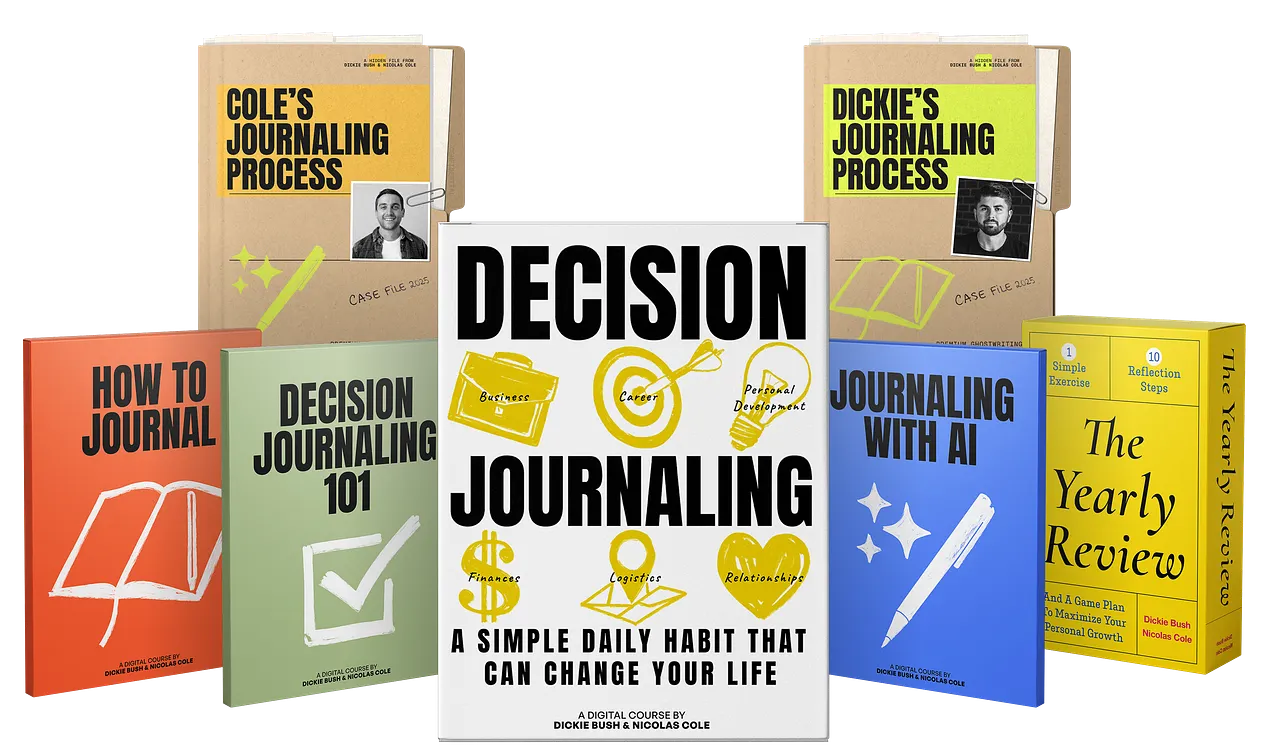
Nicolas Cole & Dickie Bush – Decision Journaling 2026
$99.00 Original price was: $99.00.$27.00Current price is: $27.00.
- 24/7 Contact Support & Telegram - Ecomkevin_1
- You Can Request Any Courses
- Original Courses HD Qualite and links updated
Guaranteed Safe Checkout


Description
Nicolas Cole & Dickie Bush – Decision Journaling Framework
Indecision and second-guessing cost digital creators and founders more energy than execution ever will. Dickie Bush and Nicolas Cole—founders of Ship 30 for 30 and Premium Ghostwriting Academy—developed the Decision Journaling Framework to eliminate mental fog, audit high-stakes choices, and build a compounding feedback loop for decision-making.
Unlike standard diary-style writing, Decision Journaling is an operational audit tool. It separates decision quality from outcome quality, keeping you from mistaking bad luck for a bad decision—or a lucky outcome for good judgment.
┌───────────────────────────────────────────────────────────────────────────┐
│                    THE DECISION JOURNALING FEEDBACK LOOP                  │
├───────────────────┬───────────────────────┬───────────────────────────────┤
│ 1. Capture Context│ 2. Predict & Document │ 3. Audit & Review             │
├───────────────────┼───────────────────────┼───────────────────────────────┤
│ • Mental state    │ • Expected outcome    │ • Review at 30 / 90 days      │
│ • Key variables   │ • Anticipated risks   │ • Compare reality vs. thesis  │
│ • Blind spots     │ • "Second-best" pick  │ • Refine mental models        │
└───────────────────┴───────────────────────┴───────────────────────────────┘
The 3 Core Pillars of Decision Journaling
1. Documenting Context at “Time Zero”
Before executing a major business shift, campaign launch, or career move, document your current reality:
-
The Problem: What specific issue are you attempting to solve?
-
Emotional State: Are you anxious, overly optimistic, fatigued, or reacting out of FOMO?
-
Information Hand: What do you know to be true right now versus what are you assuming?
2. Forcing Explicit Predictions
Hindsight bias convinces us that we “knew it all along” when things go right or wrong. To combat this:
-
The Primary Thesis: Why do you believe Option A is the optimal path?
-
Second-Best Alternative: What was Option B, and why are you rejecting it?
-
Trade-off Acknowledgment: What are you giving up by making this choice? (e.g., “Choosing this project means freezing another for 90 days.”)
3. Setting Scheduled Audits (30 / 90 / 180 Days)
A decision journal is useless without a review cadence. Set a recurring calendar notification to reopen your entry at 30, 90, or 180 days:
-
Compare the actual result against your original prediction.
-
Identify variables you failed to anticipate.
-
Log key lessons learned to upgrade your mental models.
Core Daily & Decision Prompts
| Journal Category | Prompt / Diagnostic Question | Purpose |
| Pre-Decision | “What is the 2-year downside if this thesis is completely wrong?” | Calibrates risk tolerance and prevents catastrophic downsides. |
| Opportunity Cost | “You can do anything, but not everything. What gets cut?” | Enforces resource focus across health, writing, and business. |
| Open Loop Purge | “What decision am I currently avoiding, and what energy is it draining?” | Unlocks trapped cognitive bandwidth caused by lingering tasks. |
| Monthly Review | “Which decision produced the best return on time invested?” | Identifies high-leverage activities to double down on. |
Enhancing Decision Journaling with AI
Dickie Bush and Nicolas Cole emphasize pairing traditional daily/weekly journaling with custom AI prompts (using Claude or ChatGPT) to act as a sounding board:
AI Audit Prompt: “Analyze my decision logic below. Identify 3 potential cognitive biases, highlight blind spots in my assumptions, and challenge my risk assessment with 2 alternative perspectives.”
This step introduces an objective counterweight before you finalize high-stakes choices.
Frequently Asked Questions (FAQs)
1. How is decision journaling different from standard daily journaling?
Standard journaling often focuses on emotional expression or daily recap. Decision journaling acts as a structured lab report for your choices—recording assumptions, predictions, and rationale so you can audit them later.
2. How often should I complete a decision journal entry?
You do not need to write an entry for every minor choice. Reserve formal decision journaling for major pivot points—such as strategy changes, hiring/firing decisions, financial investments, or product launches.
3. What is the single biggest trap in decision-making?
Evaluating a decision solely based on its outcome (a fallacy known as “resulting”). A good decision can yield a bad outcome due to variance or unknown variables, while a reckless decision can accidentally yield a good result. Journaling isolates the quality of your reasoning from sheer luck.
Reviews
There are no reviews yet.